
Finding the right subcontractor for a complex project often feels like looking for a needle in a haystack. Most general contractors maintain a massive vendor directory in Procore, but as that list grows, it becomes harder to navigate. You might have 5,000 companies in your database, but finding the one that is available, qualified, and reliable for a specific job in a specific city is a manual chore.
Traditional search tools rely on rigid keywords and trade codes. If a subcontractor didn't perfectly categorize themselves, they might as well not exist in your system. This is where AI is changing the game. By using AI to search vendors in Procore, you can move past simple filtering and start using your data as a competitive advantage.
The problem with manual vendor searches in Procore
Most Procore directories suffer from three main issues: they are too large, the data is often outdated, and the search tools are too basic. When an estimator needs a dry-waller for a project in Austin, they usually filter by trade code and location. But trade codes are often broad. A "Drywall" tag doesn't tell you if the sub specializes in high-end residential or massive commercial hospitals.
Manual filtering also ignores the most important data point: performance. You might find ten subcontractors who fit the basic criteria, but your directory won't immediately tell you which one caused a three-week delay on your last project. This leads to estimators falling back on the same three or four "favorite" subs, which limits competition and increases risk if those partners are overbooked.
How AI-powered search differs from keyword filtering
AI search is "semantic," meaning it understands the intent behind your query rather than just matching characters. Instead of just searching for "Electrical," an AI-powered tool can understand a request like "find electrical subs with experience in laboratory cleanrooms who have worked with us in the Southeast."
As a recent industry report on Procore's 2026 updates highlights, the shift toward "agentic AI" allows tools to look across millions of project records, specifications, and drawings to identify subcontractors who have successfully completed similar complex scopes of work. This provides a level of context that a standard keyword search simply cannot match.
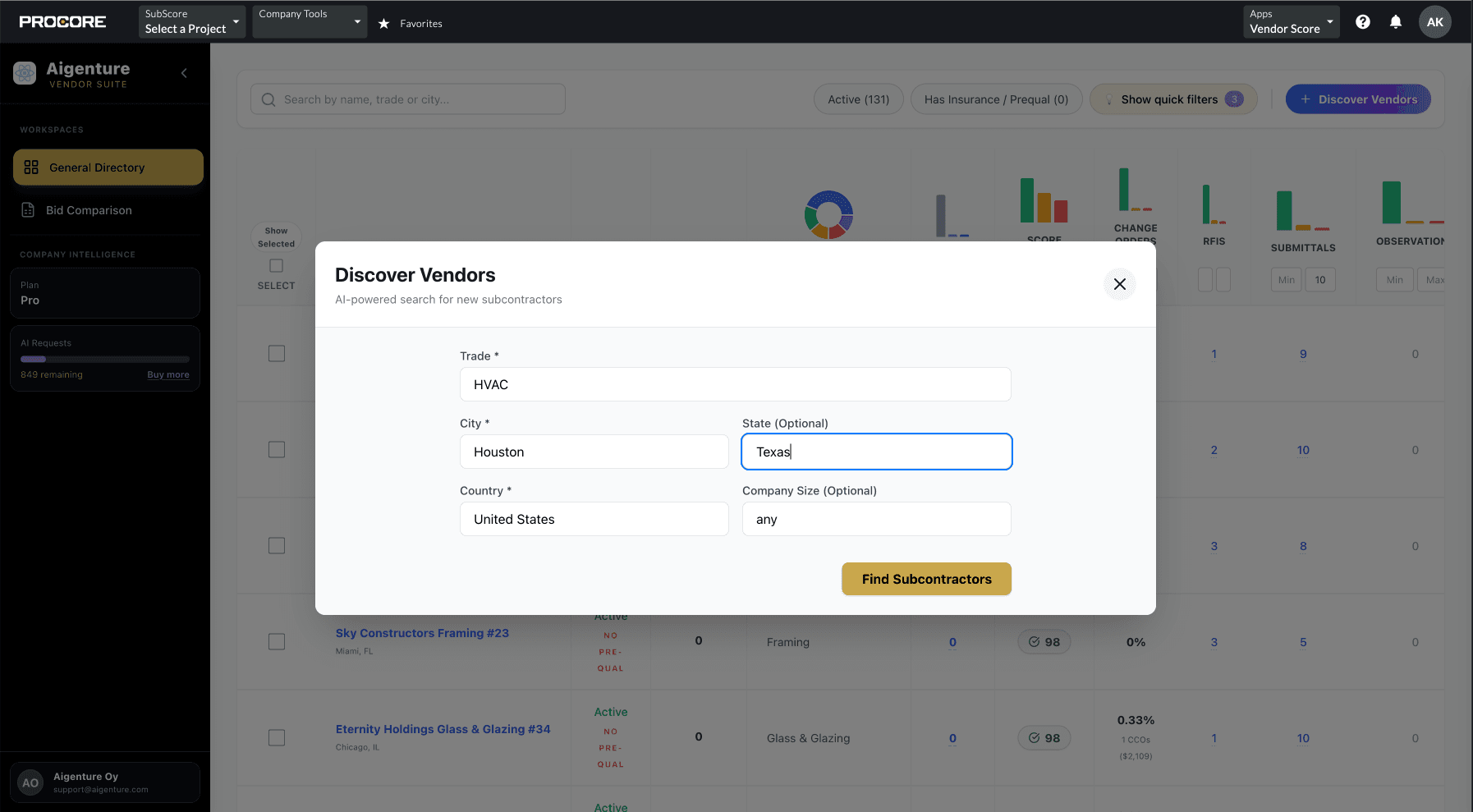
Finding subcontractors based on historical performance
The most powerful way to use AI in your Procore directory is to connect it to your field data. Every inspection, daily log, and change order in Procore is a data point about a subcontractor's reliability. Research by Smith et al. (2019) found that machine learning models can accurately predict subcontractor performance by analyzing historical project data, helping GCs avoid partners likely to miss schedule or quality targets.
When you use AI to search, you aren't just looking for a name. You are looking for a track record. You can filter your search to only show vendors with a high inspection pass rate or those who historically stay within their original bid amount. This bridges the gap between preconstruction and the field, ensuring that the "best" sub isn't just the one with the lowest price, but the one most likely to finish the job correctly.
For more on this, see our guide on How to Track and Evaluate Subcontractor Historical Performance.
Filtering by specific trade expertise and capacity
AI can also help you understand a subcontractor's current capacity. By looking at active commitments and historical project loads, AI tools can flag whether a subcontractor might be overextended. This prevents the common mistake of awarding a contract to a great partner who simply doesn't have the manpower to start on your timeline.
Furthermore, AI can identify specialized skills that aren't captured in standard trade codes. By "reading" past proposals and project descriptions, the AI knows that a specific masonry sub has extensive experience with historic restoration, even if their Procore profile just says "Masonry."
Reducing risk by discovering vetted partners
Vetting a new subcontractor is a time-consuming process that involves checking safety records, financial stability, and legal standing. AI speeds this up by performing "deep research" instantly. Instead of a human spending hours on Google and OSHA databases, an AI agent can pull a comprehensive summary of a vendor's background directly into your Procore workflow.
This allows you to expand your vendor pool without increasing your risk. You can find "new" partners who match your project requirements perfectly and have a clean bill of health, even if you've never worked with them before. This is a significant improvement over the traditional Procore subcontractor discovery guide methods which often rely on manual outreach.
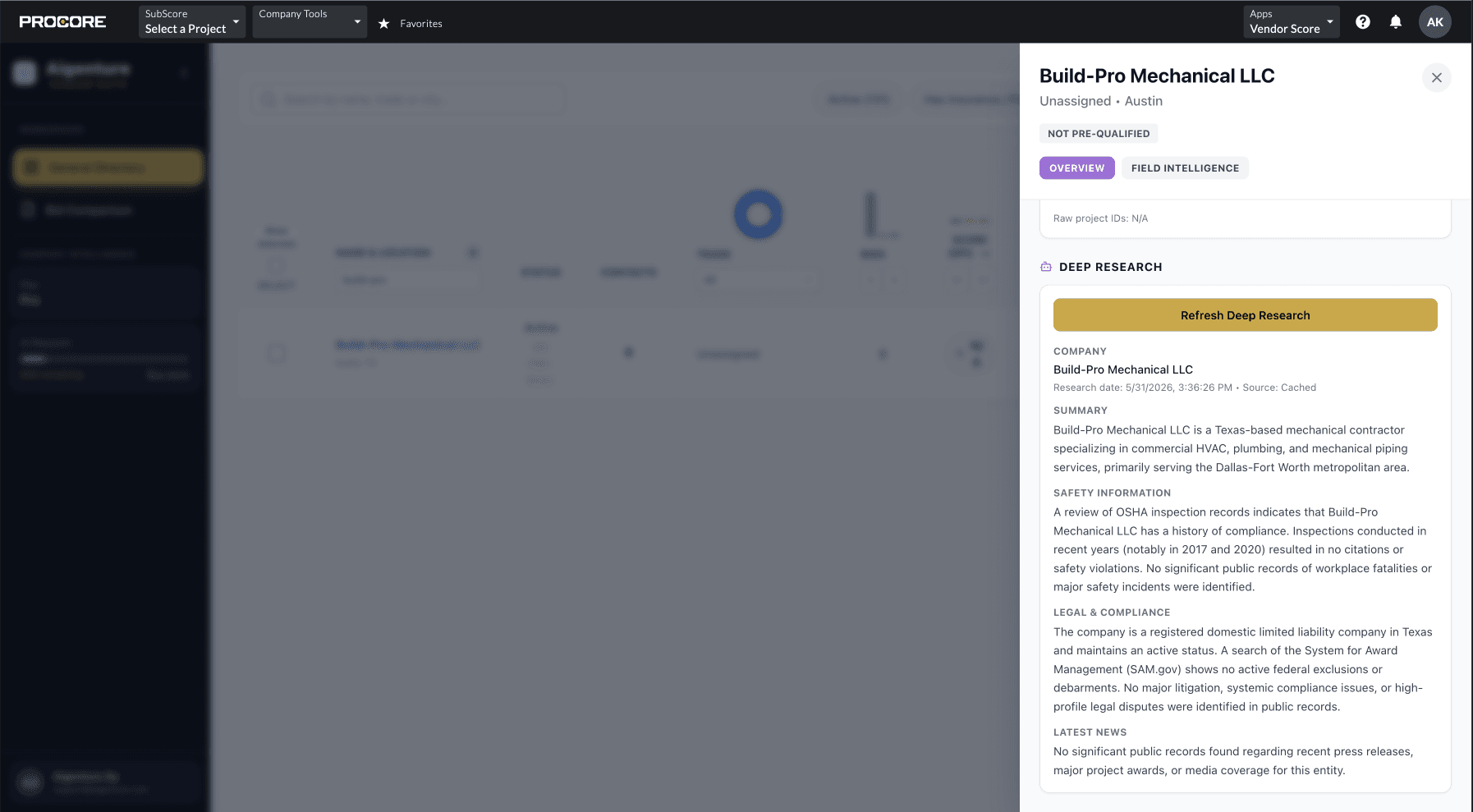
How Aigenture makes Procore vendor search 10x faster
Aigenture was built to live natively inside Procore and solve the "messy directory" problem. Our AI agents don't just search your directory; they understand it. We connect your preconstruction search to your actual field history, allowing you to filter by real-world metrics like change order percentages and quality scores.
With Aigenture, you can: - Find the right subs in seconds using natural language. - See a "Field Intelligence" summary for every vendor before you invite them to bid. - Perform deep background checks on new vendors with one click. - Keep your directory clean and useful without manual data entry.
By turning your Procore data into a decision engine, Aigenture helps you award contracts faster and with more confidence.
Ready to see how AI can transform your vendor discovery? View Plans or start your 30-day free trial today.
References
- Smith, J. et al. (2019). "Predicting Subcontractor Performance Using Artificial Intelligence." Journal of Construction Engineering and Management.
- "Procore Agentic AI (Powered by Datagrid)." Procore News.
- "Integrating AI into Procurement Processes in Construction." Engineering, Construction and Architectural Management.